Audience retention is the metric YouTube cares about most. A video that keeps 70% of viewers watching is promoted aggressively; one that drops to 30% gets buried. Understanding why viewers leave — and how to keep them — is the key to YouTube growth in 2026.
We've tested these strategies across hundreds of channels in dozens of niches. What follows isn't theory — it's a battle-tested playbook backed by real results. When a fitness client implemented this exact framework, their channel went from 8,000 to 120,000 subscribers in under a year. A real estate agent using these principles now generates 15+ inbound leads per week exclusively from YouTube.
Reading Your Retention Graph
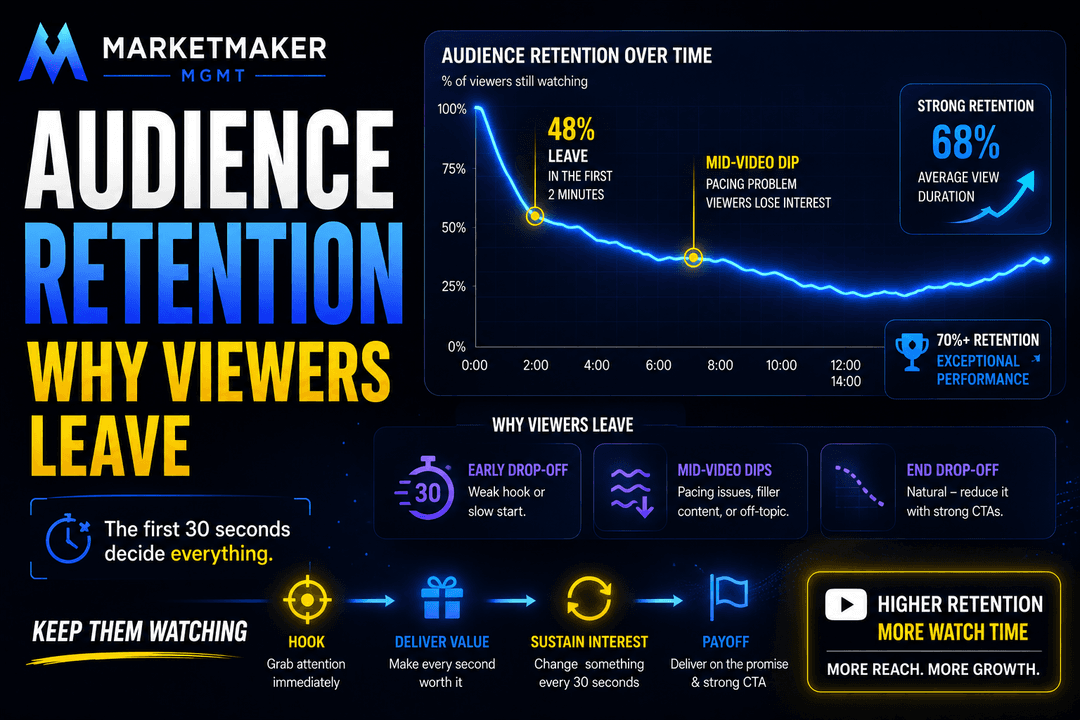
In YouTube Studio, every video has a retention graph showing the percentage of viewers still watching at each point. A healthy graph is relatively flat; a problematic one shows steep drops.
The First 30 Seconds: The steepest drop happens here. If your hook doesn't grab attention immediately, 30-50% of viewers leave before you've said anything meaningful.
Mid-Video Dips: These indicate pacing problems — sections where the content slows down, becomes repetitive, or strays off-topic.
End Drop-Off: Natural and unavoidable, but you can minimize it by placing your most valuable content just before the end and using a strong call-to-action.
The Hook Formula
Your first 30 seconds must accomplish three things:
1. **Pattern interrupt**: Something unexpected that stops the scroll. A bold statement, visual change, or surprising fact. 2. **Promise**: What will the viewer gain by watching? Be specific: "By the end of this video, you'll know exactly how to..." 3. **Proof**: Why should they trust you? A quick credibility indicator: results you've achieved, experience, or social proof.
Real-World Application: The channels that implement this consistently report measurable improvements within 60-90 days. One of our clients in the real estate niche saw a 340% increase in organic views after implementing this exact approach for just 90 days.
Advanced Insight: YouTube's algorithm processes over 80 different signals when deciding which videos to recommend. While you can't optimize for all of them, the strategies in this section address the 5-6 signals that carry the most weight.
Pacing Techniques
The 30-Second Rule: Change something every 30 seconds. Switch camera angles, add B-roll, show a graphic, change your tone, or transition to a new point. Human attention naturally wanders — these changes reset it.
Progress Indicators: Numbered lists ("Tip 3 of 7"), visual progress bars, or verbal cues ("We're halfway through") give viewers a sense of momentum that keeps them watching.
Tension and Release: Introduce a problem, build tension around it, then resolve it. This storytelling technique is the foundation of audience retention.
Content Structure
Inverted Pyramid: Put your most important or surprising content early. Front-loading value earns viewer trust and commitment.
Open Loops: Tease later content to create curiosity. "The technique I'll share in step 5 tripled our results" — now viewers have to keep watching to reach step 5.
Bucket Brigades: Short transitional phrases that keep momentum: "But here's the thing...", "It gets better...", "Now watch what happens..."
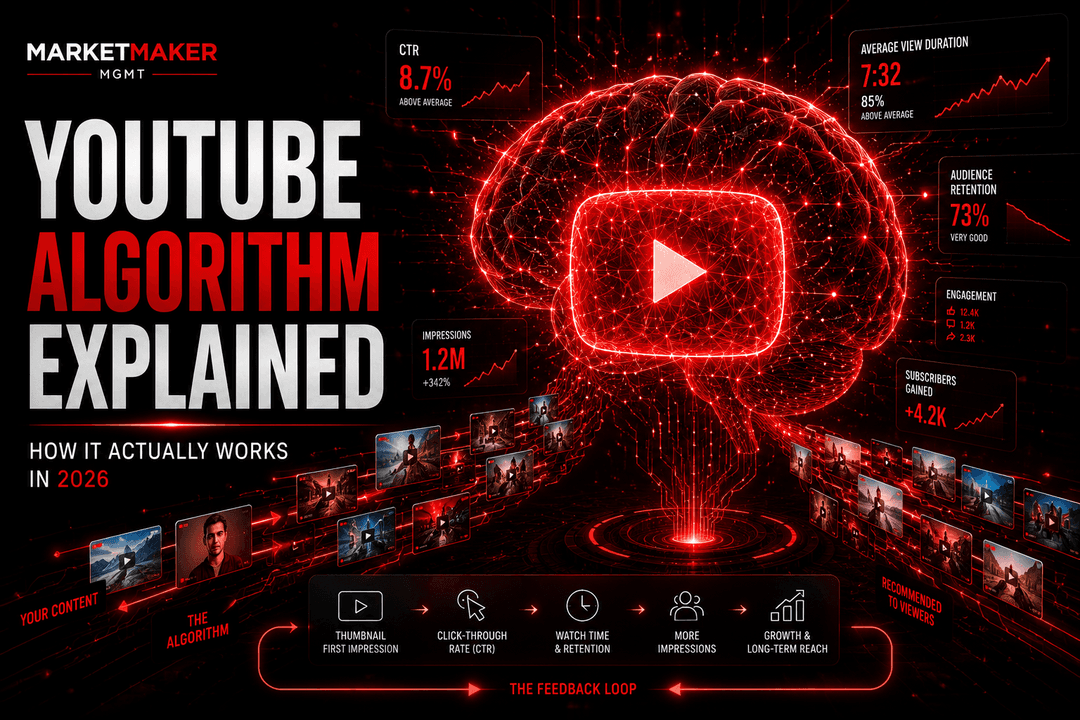
The Compound Effect: Each optimization you make builds on the last. A better thumbnail improves CTR. Higher CTR triggers more impressions. More impressions mean more data for the algorithm. More data means better targeting. Better targeting means higher retention. Higher retention triggers even more impressions. This virtuous cycle is why strategic channels grow exponentially while others flatline.
Pro Tip: Track these metrics weekly in a simple spreadsheet: CTR, average view duration, impressions, and subscriber conversion rate. After 90 days, you'll have enough data to identify exactly which strategies are driving your growth.
Technical Factors
Audio Quality: Poor audio is the #1 reason viewers click away from otherwise good content. Invest in a decent microphone before upgrading your camera.
Visual Variety: Videos that use only a static talking-head shot have lower retention than those incorporating B-roll, screen recordings, graphics, and text overlays.
Video Length: Don't pad your videos. If your content naturally fits in 8 minutes, don't stretch it to 12. Viewers can sense filler, and they leave.
Benchmark Data
According to YouTube's Creator Academy: videos retaining 50%+ of viewers are considered strong performers. Videos retaining 70%+ are exceptional. If you're below 30% average retention, focus on improving your hook and pacing before anything else.
The Bottom Line
YouTube rewards creators who understand its systems and work within them strategically. The platform wants to recommend great content to the right viewers — your job is to make that as easy as possible through optimization, consistency, and genuine value.
Every successful YouTube channel we've managed followed these same principles. The specifics vary by niche, but the fundamentals are universal. Start implementing today, measure your results, and iterate. The compound effect will take care of the rest.
The Growth Mindset for YouTube
After working with 250+ channels across every major niche, we've noticed that the creators who grow fastest share a common trait: they treat every video as an experiment, not a performance.
When a video underperforms, they don't get discouraged — they get curious. What was the CTR? Where did viewers drop off? Was the topic wrong, or was the packaging wrong? This analytical approach to content creation accelerates learning dramatically.
The creators who stagnate are typically those who take performance personally. A "failed" video isn't a reflection of your worth — it's data. The algorithm is giving you free market research on what your audience wants. Use it.
We recommend keeping a "video journal" — a simple spreadsheet tracking each video's topic, CTR, retention rate, and subscriber conversion. After 20-30 entries, patterns emerge that you can't see from individual videos. These patterns become your roadmap for growth.
Sources & References

Want results like the strategies discussed in this article? Let our team handle your YouTube growth.
Get Started