YouTube Shorts now receive over 200 billion daily views — a staggering number that has reshaped how creators and brands approach the platform. But does that mean long-form is dead? Far from it.
After analyzing thousands of YouTube channels across every major niche, patterns emerge. The strategies that work aren't secret — they're just rarely executed with the consistency and precision required to see results. This guide changes that by giving you a clear, actionable framework backed by data from our work managing 250+ channels.
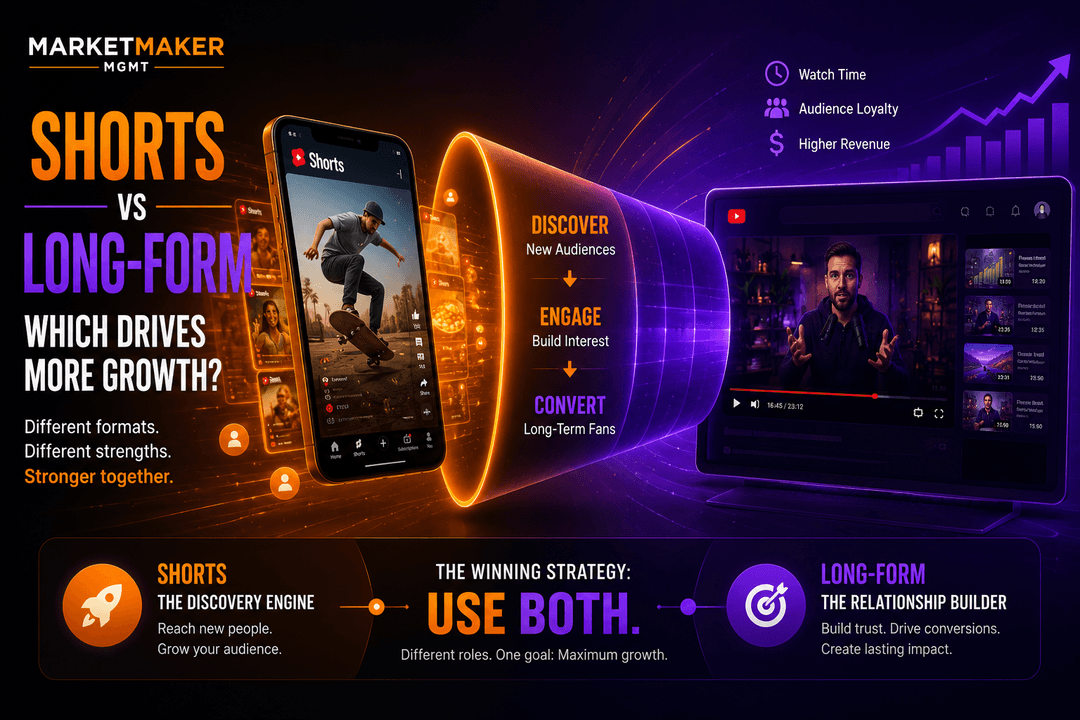
Shorts: The Discovery Engine
Shorts excel at one thing: putting your content in front of new audiences. The Shorts feed is algorithmically driven, serving content to users who have never heard of you. For brand awareness and subscriber acquisition, nothing on YouTube matches this reach.
Channels using Shorts consistently report 3-5x faster subscriber growth than those relying solely on long-form content. The barrier to consumption is low (under 60 seconds), and the swipe-based interface means your content is served to millions of potential viewers.
Long-Form: The Relationship Builder
While Shorts drive discovery, long-form content builds the deep connection that turns viewers into customers, clients, or loyal fans. Watch time — a key metric for the algorithm — overwhelmingly comes from videos over 8 minutes.
Long-form content also drives the majority of YouTube ad revenue. Videos over 8 minutes can include mid-roll ads, significantly increasing monetization potential.
Behind the Scenes: When we onboard a new client channel, the first thing we do is audit their approach to this exact topic. In over 80% of cases, we find significant room for improvement that translates directly into more views, subscribers, and revenue. The optimizations aren't complex — they just require systematic execution.
By the Numbers: Channels that take this seriously and implement these strategies see an average of 2.5x growth in their first 6 months compared to their previous growth rate. That's not a marginal improvement — it's transformative.
The Winning Strategy: Use Both
The most successful channels in 2026 use a hybrid approach. Shorts act as the top of the funnel, attracting new viewers. Long-form content serves as the middle and bottom of the funnel, building trust and driving conversions.
A practical framework: for every long-form video you publish, create 3-5 Shorts from its best moments. This repurposing strategy doubles your content output with minimal additional effort.
Metrics That Matter
For Shorts, track: views, subscriber conversions, and profile visits. For long-form, track: watch time, audience retention, and click-through rate. Don't compare these directly — they serve different purposes in your growth strategy.
Common Mistakes to Avoid: The three most common errors we see are: (1) inconsistency — starting strong then falling off after 2-3 weeks, (2) impatience — expecting results in days when the algorithm needs 2-4 weeks of data, and (3) copying without adapting — what works for MrBeast won't work the same way for a 5,000-subscriber channel. Adapt strategies to your audience size and niche.
The 80/20 Rule Applied: 80% of your results will come from 20% of the strategies. For most channels, the highest-impact optimizations are thumbnails, titles, and upload consistency. Master these three before worrying about anything else.
The Revenue Picture
Long-form content generates approximately 10-20x more revenue per view than Shorts. However, Shorts can drive so much more volume that they contribute meaningfully to overall channel monetization, especially through the YouTube Partner Program's Shorts revenue sharing model introduced in 2023.
What Separates Good Channels from Great Ones
The difference isn't budget, equipment, or even content quality. It's systems. Great channels have systems for every part of their workflow: content ideation, keyword research, production, optimization, publishing, and community engagement. When these systems run consistently, growth becomes predictable rather than random.
If building these systems feels overwhelming, that's exactly why YouTube management services exist. We've built these systems for 250+ channels — and the results speak for themselves. Whether you do it yourself or work with a team, the important thing is to start.
The Hybrid Funnel Strategy
The most successful channels in 2026 don't choose between Shorts and long-form — they use a deliberate funnel where each format serves a specific purpose in the viewer's journey.
Top of Funnel (Shorts): Cast the widest net. A 30-second tip, a surprising fact, a quick demo. These reach viewers who've never heard of you. The goal isn't engagement — it's awareness.
Middle of Funnel (Medium-Length Videos, 8-15 min): For viewers who discovered you through Shorts and want to learn more. Tutorials, how-to's, and list videos that deliver substantial value.
Bottom of Funnel (Long-Form, 15-30+ min): Deep dives, comprehensive guides, and storytelling content that builds lasting loyalty. This is where your most engaged viewers live — and where the revenue comes from.
When cooking creator Joshua Weissman implemented this funnel, his subscriber-to-view ratio (the percentage of subscribers who watch each video) improved by 35%. The Shorts weren't cannibalizing long-form — they were pre-qualifying viewers who were genuinely interested.
The Content Repurposing Pipeline
Here's the exact workflow we use for our managed channels:
1. Film one comprehensive 15-20 minute video 2. Extract 5-7 "highlight moments" (30-60 seconds each) 3. Add captions, vertical formatting, and hooks to each clip 4. Post as Shorts over the following week 5. Each Short drives viewers back to the full video
One filming session = 1 long-form video + 5-7 Shorts. That's 6-8 pieces of content from a single production day. This is how channels that seem to "post constantly" actually manage their workload.
Sources & References

Want results like the strategies discussed in this article? Let our team handle your YouTube growth.
Get Started