Audience retention is the single most important metric for YouTube success, and it starts with your script. A well-structured script keeps viewers engaged from the first second to the last, signaling to the algorithm that your content is worth promoting.
We've tested these strategies across hundreds of channels in dozens of niches. What follows isn't theory — it's a battle-tested playbook backed by real results. When a fitness client implemented this exact framework, their channel went from 8,000 to 120,000 subscribers in under a year. A real estate agent using these principles now generates 15+ inbound leads per week exclusively from YouTube.
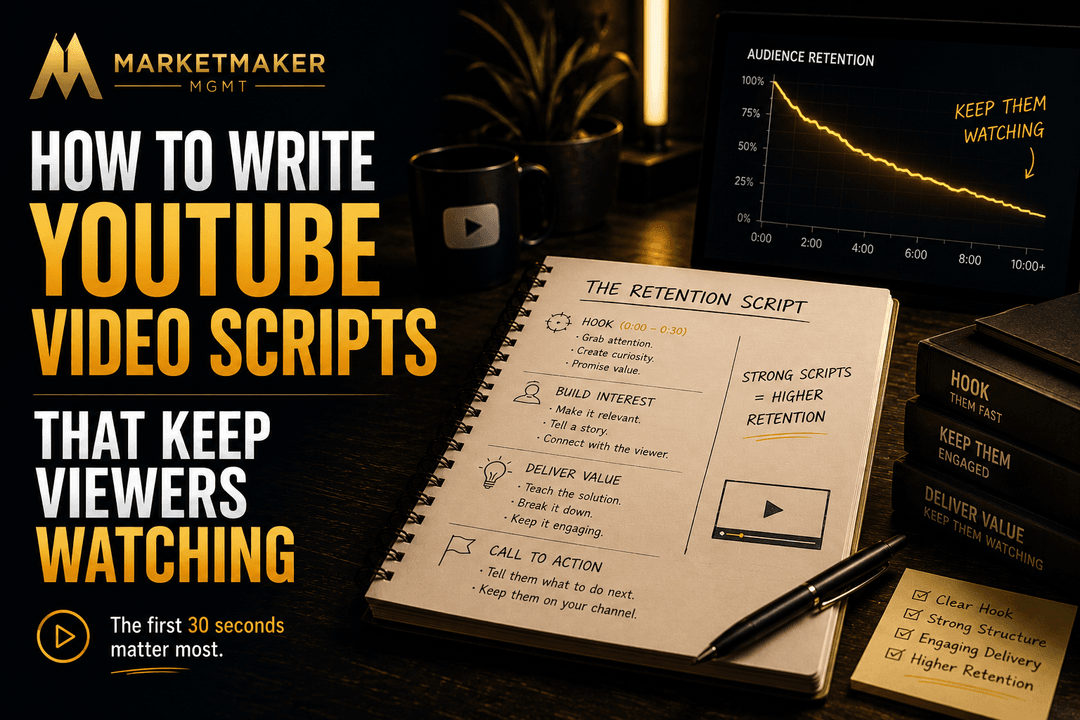
The Hook: First 30 Seconds
YouTube's data shows that viewers decide whether to keep watching within the first 30 seconds. Your hook needs to accomplish three things: grab attention, establish relevance, and promise value.
Pattern Interrupt: Start with something unexpected. A bold statement, a surprising statistic, or a provocative question breaks the viewer out of their scrolling autopilot.
The Promise: Tell viewers exactly what they'll learn or gain by watching. "By the end of this video, you'll know the exact strategy we used to grow channels by 500% in 6 months."
Credibility: Briefly establish why they should listen to you. "After managing 250+ YouTube channels..."
The AIDA Framework for YouTube
Attention: Your hook (first 30 seconds).
Interest: Present the problem or opportunity in detail. Use stories, statistics, or relatable scenarios that make viewers think "this applies to me."
Desire: Reveal the solution. This is your main content — tips, strategies, tutorials. Structure this in a numbered or step-by-step format to create a sense of progression.
Action: End with a clear call-to-action. Subscribe, watch the next video, visit your website, or implement what they learned.
Real-World Application: The channels that implement this consistently report measurable improvements within 60-90 days. One of our clients in the real estate niche saw a 340% increase in organic views after implementing this exact approach for just 90 days.
Advanced Insight: YouTube's algorithm processes over 80 different signals when deciding which videos to recommend. While you can't optimize for all of them, the strategies in this section address the 5-6 signals that carry the most weight.
Retention Techniques
Open Loops: Tease upcoming content to keep viewers watching. "I'll share the biggest mistake in tip #5 — it's the one most people don't see coming."
Pattern Changes: Shift your energy, visual style, or topic every 2-3 minutes. This prevents viewer fatigue and resets attention.
Timestamps: Adding chapters makes your content navigable and encourages viewers to watch specific sections rather than clicking away entirely.
Scripting for Different Formats
Tutorials: Problem → Solution → Step-by-step process → Results
List Videos: Hook → Item-by-item with increasing value → Best item saved for last
Story-Based: Setup → Conflict → Resolution → Lesson
Opinion/Commentary: Bold stance → Supporting evidence → Counterarguments → Conclusion
The Compound Effect: Each optimization you make builds on the last. A better thumbnail improves CTR. Higher CTR triggers more impressions. More impressions mean more data for the algorithm. More data means better targeting. Better targeting means higher retention. Higher retention triggers even more impressions. This virtuous cycle is why strategic channels grow exponentially while others flatline.
Pro Tip: Track these metrics weekly in a simple spreadsheet: CTR, average view duration, impressions, and subscriber conversion rate. After 90 days, you'll have enough data to identify exactly which strategies are driving your growth.
Speaking Naturally
A script shouldn't sound scripted. Write the way you speak, then read it aloud and edit for natural rhythm. Bullet points with key phrases often work better than word-for-word scripts because they force a more conversational delivery.
The Bottom Line
YouTube rewards creators who understand its systems and work within them strategically. The platform wants to recommend great content to the right viewers — your job is to make that as easy as possible through optimization, consistency, and genuine value.
Every successful YouTube channel we've managed followed these same principles. The specifics vary by niche, but the fundamentals are universal. Start implementing today, measure your results, and iterate. The compound effect will take care of the rest.
Why This Matters More Than Ever in 2026
The YouTube landscape in 2026 is simultaneously more competitive and more opportunity-rich than ever before. The platform reaches 2.7+ billion monthly users, but only a fraction of potential creators are producing strategic, optimized content.
This means the gap between strategic creators and casual uploaders is widening. Channels that implement the approaches outlined in this guide are pulling further ahead, while those relying on "post and pray" strategies are falling further behind.
The good news? The fundamentals haven't changed: provide genuine value, optimize for discovery, and show up consistently. These principles worked in 2020, they work in 2026, and they'll work in 2030. The specific tactics evolve, but the core strategy of serving your audience better than anyone else never goes out of style.
Whether you implement these strategies yourself or partner with a professional YouTube management team, the important thing is to start. Every day you wait is a day your competitors are building the library, audience, and algorithmic momentum that will be increasingly difficult to catch.
Sources & References

Want results like the strategies discussed in this article? Let our team handle your YouTube growth.
Get Started